
When the Renewal Notice Raises the Question
You made the last payment three years ago. Your car sits in the driveway most of the week. You drive to the grocery store, the doctor, maybe out to visit family once a month. Then the renewal notice arrives and the premium is $127 a month for full coverage on a vehicle Kelley Blue Book values at $4,200. You start wondering whether you're paying for coverage that no longer earns its cost.
This is the collision coverage question every Fresno retiree with a paid-off car faces, and most keep full coverage by inertia long after the arithmetic stops working. The decision isn't about age or ability. It's about whether the collision and comprehensive premiums still make sense against what you'd actually recover if the car were totaled or stolen, now that you drive a fraction of your working-year mileage and no lender requires coverage.
Compare rates from carriers that specialize in senior drivers
Mature driver discounts, low-mileage rates, and coverage reviews — see what you're actually eligible for.
Get Your Free QuoteCalifornia Minimum Property Damage
$15,000
California requires $15,000 property damage liability as part of the 15/30/15 minimum. This is the floor you must carry whether you drop collision or keep it. The minimum protects the other driver's vehicle, not yours.
CA Vehicle Code §16056
What Full Coverage Actually Protects on a Paid-Off Vehicle
Full coverage means collision and comprehensive on top of your liability policy. Collision pays to repair or replace your car after an accident you cause or a hit-and-run with no other party to recover from. Comprehensive covers theft, vandalism, weather damage, and animal strikes. Both pay up to actual cash value minus your deductible, and actual cash value on a ten-year-old sedan in Fresno is often $3,000 to $5,000.
When the car was financed, the lender required both coverages to protect their loan collateral. Now that you own the car outright, the decision is yours. The coverage still works the same way, but you're paying the premium to protect an asset worth less each year, and you're driving that asset far less than you did during your commuting years. The question is whether the annual premium justifies what you'd recover in a total loss, after subtracting the deductible.
Many Fresno retirees discover their combined collision and comprehensive premium runs $800 to $1,200 annually on a vehicle whose replacement value sits below $5,000. A $1,000 deductible reduces the maximum net recovery further. If the car's value is $4,000 and your deductible is $1,000, the most you'd collect in a total loss is $3,000. After two or three years of premiums, you've paid more than you'd ever recover.
You cannot recover more than actual cash value minus your deductible, and collision premium does not decrease as the vehicle ages and depreciates.
The Coverage-Fit Threshold for Lightly-Driven Older Cars
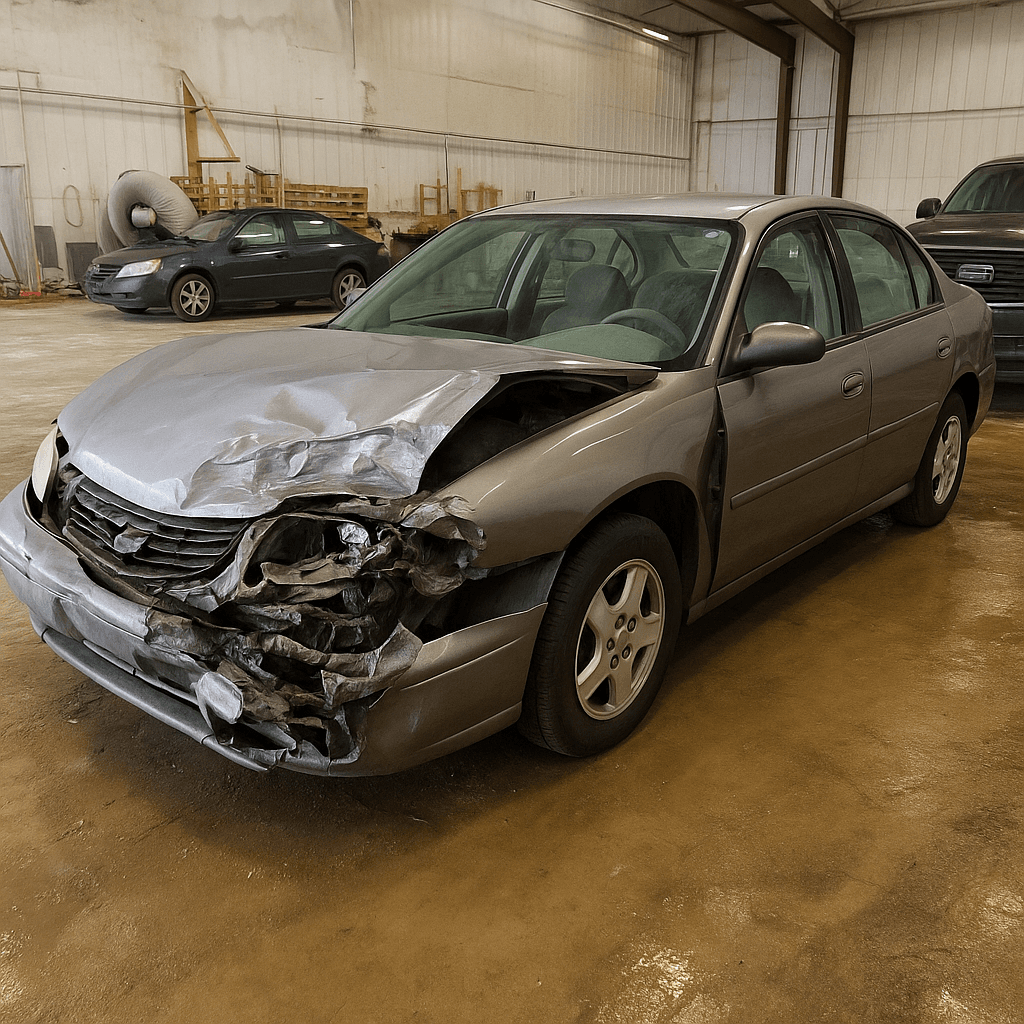
When annual collision and comprehensive premiums together exceed 10 percent of the vehicle's current value, most financial advisors suggest dropping both and banking the premium savings in a vehicle replacement fund. For a $4,000 car, that threshold is $400 per year. Many Fresno retirees pay two or three times that figure and never run the math. The coverage is costing more over a three-year period than the car is worth, and you're funding coverage on an asset whose value drops every renewal cycle.
The second decision point is out-of-pocket capacity. If the car were totaled tomorrow and insurance paid nothing, could you replace it from savings or monthly income without financial hardship? If yes, you're effectively self-insuring, and paying the carrier to do what you could manage yourself. If no, and losing the car would strand you without transportation, the collision premium may still be worth carrying despite the unfavorable math, because the alternative is worse. This is a judgment call only you can make, and it has nothing to do with your driving record or ability.
Related Articles
California's Mature-Driver Discount Does Not Offset Collision Premium
California Insurance Code Section 11628.3 requires insurers writing auto policies in the state to offer a mature-driver discount for drivers aged 55 and older who complete a state-approved defensive driving course. The statute does not fix the discount percentage; each insurer sets the amount by filed rate schedule. The discount applies to the entire policy premium, which means it reduces liability, collision, and comprehensive together, but it does not eliminate collision cost.
Most Fresno retirees who complete the course see premium reductions between 5 and 15 percent depending on the carrier. On a $1,500 annual policy, a 10 percent discount saves $150. That helps, but it does not change the collision coverage question on a paid-off older vehicle. You're still paying $700 or $900 annually to insure an asset worth $4,000, and the discount reduces that figure by a fraction, not to zero. The mature-driver discount improves the overall rate; it does not resolve whether collision coverage still fits your situation.
Some Fresno carriers combine the mature-driver discount with low-mileage programs that reduce premiums for drivers logging under 7,500 miles per year. GEICO, Progressive, Nationwide, and State Farm all offer mileage-tracking or self-reported annual mileage discounts. Stacking both can drop your total premium by 20 to 30 percent in favorable cases, but again, this reduces collision cost; it does not answer whether collision itself is worth keeping. The decision remains the same: compare annual premium against net recovery after deductible.
California Minimum Bodily Injury Per Person
$30,000
Liability coverage protects your retirement assets if you cause an accident. California's 15/30/15 minimum is $30,000 per person, $60,000 per accident. Most financial planners recommend retirees carry $100,000/$300,000 or higher to shield home equity and savings from lawsuit exposure.
CA Vehicle Code §16056
What Liability Limits Make Sense When You Drop Collision
Dropping collision does not reduce your liability exposure. If anything, the liability decision becomes more important once collision is gone, because you're signaling you have assets worth protecting and you've decided the car itself isn't one of them. California's 15/30/15 minimum—$15,000 property damage, $30,000 bodily injury per person, $60,000 per accident—was set decades ago and does not reflect current medical costs or vehicle replacement prices. A single emergency-room visit after a moderate accident often exceeds $30,000.
Retirees in Fresno who own a home, hold retirement accounts, or have any asset a plaintiff could pursue in a lawsuit should carry liability limits high enough to shield those assets. Many planners recommend $100,000 per person and $300,000 per accident as a floor, with $500,000 or an umbrella policy layered on top for homeowners with substantial equity. Liability premium increases modestly as limits rise—often $10 to $20 per month to double your coverage—while collision premium stays flat regardless of liability limits. You save money by dropping collision, not by cutting liability.
Medical payments coverage and Medicare interact in ways most Fresno retirees misunderstand. MedPay is optional in California and covers your medical bills after an accident regardless of fault, up to the policy limit. Medicare is primary for most seniors, meaning Medicare pays first and MedPay covers deductibles, copays, or expenses Medicare denies. If you carry MedPay at $5,000 or $10,000, it fills Medicare gaps without duplicating benefits. Some retirees drop MedPay entirely once on Medicare, others keep a small limit as secondary coverage. This is separate from the collision question and worth reviewing with your carrier.
How to Compare Liability-Only vs Full Coverage Across Carriers
Request quotes from at least three carriers writing in California with both full coverage and liability-only scenarios. Use identical liability limits, deductibles, and annual mileage in both quotes so the comparison isolates collision and comprehensive cost. GEICO, Progressive, State Farm, Farmers, and Allstate all write standard auto policies in Fresno and provide online quotes. Mercury General and CSAA are California-based carriers worth including if you've been with a national brand for years and never compared.
When you call or quote online, specify your current vehicle year, make, model, and estimated current mileage. Many quote tools default to higher coverage than you need. Confirm the liability limits match what you want, verify the deductible, and ask whether the mature-driver discount and any low-mileage program are applied. Some carriers require the defensive-driving certificate up front; others apply the discount retroactively once you submit proof of completion. The certificate must come from a California DMV-approved provider—your county's Area Agency on Aging or AARP's online course are the most common paths.
Switch Coverage at Renewal, Not Mid-Term
Drop collision and comprehensive at your policy renewal date, not mid-term. Removing coverage mid-term triggers a recalculated premium and a small refund, but it also restarts underwriting in some cases and may cost you a multi-policy or continuous-coverage discount if the carrier re-rates you as a new liability-only customer. Switching at renewal preserves your policy anniversary, your discount tenure, and avoids the administrative friction of a mid-term endorsement. If your renewal is four months out and you've decided to drop collision, note the date and request the change 30 days before renewal when your carrier sends the declaration page.
Once you've dropped collision, you will not get it back without a new underwriting review, and many carriers will not reinstate collision on a vehicle older than seven or eight years even if you ask. This is a one-direction decision for most older paid-off cars. If that makes you uncomfortable, keep collision one more year, set aside the annual premium amount in a separate savings account, and revisit the decision at the following renewal. One year of premium in the bank gives you a clearer picture of whether you're comfortable self-insuring the vehicle going forward.