
When the Premium Outlasts the Loan
You made the final car payment three years ago. The lender released the lien, you kept the same policy, and nothing about your coverage changed—except now you're paying for collision and comprehensive protection on a car you own outright, drive less than a third of your working-year mileage, and park in the same Los Angeles garage six days a week. The monthly bill stayed the same, but the math underneath it shifted the day the loan ended.
Full coverage made sense when the bank required it. The question now isn't whether you're legally required to carry it—you're not, once the lienholder is gone—but whether the collision and comprehensive premiums you pay each year still protect more value than they cost. That calculation changes as the car ages, and most renewal notices never show you the work.
Compare rates from carriers that specialize in senior drivers
Mature driver discounts, low-mileage rates, and coverage reviews — see what you're actually eligible for.
Get Your Free QuoteCalifornia Property Damage Minimum
$15,000
Once your car is paid off, only liability coverage remains legally required in California. The $15,000 property damage floor protects others when you're at fault; collision and comprehensive protect your own vehicle and become purely financial decisions.
California auto_insurance_state_data
What Full Coverage Actually Protects Now
Collision pays to repair or replace your car when you hit another vehicle or object, regardless of fault. Comprehensive covers theft, vandalism, weather damage, and hitting an animal. Both operate on a per-incident deductible basis—you pay the first $500 or $1,000, the insurer pays the rest, up to the car's actual cash value at the time of loss.
Actual cash value is not what you paid for the car, not what you owe on it, and not what it would cost to buy a replacement today. It's the depreciated market value the moment before the loss—what a willing buyer would pay for your specific vehicle in its pre-accident condition. A 2016 sedan with 80,000 miles that sold for $28,000 new might carry an actual cash value around $9,000 to $11,000 today, depending on condition and local market. That ceiling is what collision and comprehensive protect.
If your car is totaled and the insurer determines its actual cash value was $10,000, you receive $10,000 minus your deductible. If you've been paying $1,800 annually for collision and comprehensive combined, you've paid the equivalent of the car's protected value in under six years of premiums—and that's before accounting for the deductible you'd pay out of pocket in a total loss.
The crossover happens when annual collision and comprehensive premiums approach 10 to 15 percent of the car's actual cash value—the point where you're paying near-replacement cost to insure against it.
Calculating Your Crossover Point
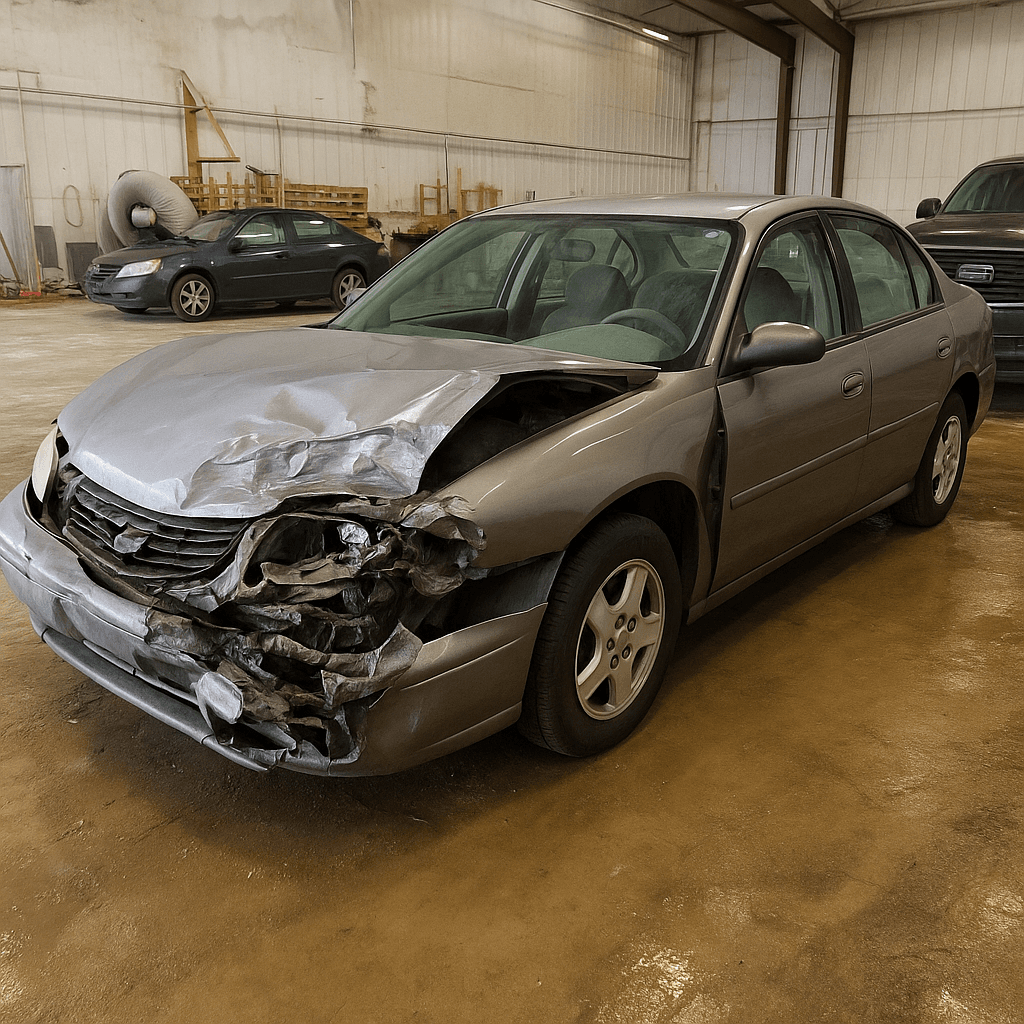
Start with your car's actual cash value. Check Kelley Blue Book or Edmunds for your vehicle's current trade-in value in your ZIP code—that's the conservative floor. Then pull your current policy declarations page and isolate the annual premium for collision and comprehensive only, excluding liability, medical payments, and any other coverages. Divide the annual premium by the vehicle's current value. If that percentage exceeds 10 percent, you're paying a meaningful fraction of the car's worth each year to insure against its loss.
Now add your deductible to the equation. If your car is worth $9,000, your annual collision and comprehensive premium is $1,400, and your deductible is $1,000, a total loss pays you $8,000 after the deductible. You'll recover your annual premium in under six payouts—but total losses are rare for experienced drivers with clean records. The expected-value calculation tilts against full coverage as the car ages and the gap between premium and protected value narrows.
Related Articles



Los Angeles Collision and Theft Context
Los Angeles theft rates and collision frequency shape the risk profile comprehensive and collision premiums price. Certain ZIP codes in Los Angeles carry higher theft rates for specific makes and models, and insurers price comprehensive coverage to match. If your 2016 sedan sits in a garaged parking spot in a lower-theft neighborhood, your theft risk is materially lower than the citywide average, but your premium may not fully reflect that unless you've confirmed your garaging discount is applied.
Collision risk in Los Angeles correlates more with annual mileage than with ZIP code. A retiree driving 4,000 miles annually faces roughly one-third the collision exposure of a commuter driving 12,000 miles in the same area. Collision premiums do not automatically adjust when your mileage drops after retirement—most carriers require you to report the change and request a mileage-tier adjustment. If you haven't updated your annual mileage estimate since you stopped commuting, you're likely overpaying for collision coverage you rarely use.
Ask your current carrier whether a low-mileage program or a usage-based telematics program applies to collision premiums. Carriers writing in California including Geico, Progressive, and Nationwide offer mileage-based adjustments that reduce collision costs when annual mileage falls below threshold levels. The reduction compounds the coverage-fit question: if collision premium drops by 20 percent after a mileage update, the crossover point shifts later; if it stays flat, the case for dropping it strengthens.
Carriers Writing in California
25
California seniors comparing collision and comprehensive costs have access to 25 carriers with verified state licensure, spanning preferred, standard, and non-standard tiers. Several, including State Farm, USAA, Geico, and Progressive, offer mature-driver and low-mileage programs that reduce full-coverage premiums when both qualifications apply.
auto_insurance_carriers_by_state CA extract
Mature-Driver and Low-Mileage Discount Interaction
California Insurance Code section 11628.3 requires insurers writing in the state to offer a mature-driver discount for operators age 55 and older. The statute does not fix the discount percentage—each insurer sets the amount by filed rate schedule—but the discount is legally mandated, not discretionary. If you have not asked your current carrier what percentage applies to your policy and whether you're receiving it, request clarification at your next renewal.
Low-mileage discounts are voluntary carrier programs, not state-mandated, and eligibility thresholds vary. Some carriers apply a low-mileage discount when annual mileage falls below 7,500 miles; others set the floor at 5,000 or require enrollment in a telematics program that verifies actual miles driven. The two discounts can stack—mature-driver applied to the base rate, low-mileage applied after—but only if you've reported both qualifications and confirmed both are active on your current policy. Most carriers do not apply discounts retroactively; the reduction begins at the next renewal after you submit documentation.
When Dropping Collision and Keeping Comprehensive Makes Sense
Collision and comprehensive are not all-or-nothing. You can drop collision and keep comprehensive if theft, vandalism, or weather risk exceeds collision risk given your low annual mileage. Comprehensive premiums are typically 40 to 60 percent lower than collision premiums for the same vehicle, and comprehensive covers scenarios—catalytic converter theft, hail damage, broken windows—that have nothing to do with how much you drive.
This split makes sense when your car's value still justifies some physical-damage protection but collision premiums alone exceed the 10-percent crossover threshold. A $9,000 car with $600 annual comprehensive premium and $1,200 annual collision premium hits the crossover on collision but not on comprehensive. Dropping collision cuts your physical-damage cost by two-thirds while preserving protection against the non-driving risks that persist even when the car sits parked.
Confirm your current collision and comprehensive premiums are itemized separately on your declarations page before making the decision. Some carriers quote them as a combined line; if yours does, call and request the breakdown. The split determines whether partial removal is viable or whether dropping both is the cleaner financial move.
Compare Before You Drop
Before removing collision or comprehensive from your current policy, compare what three other California carriers would charge for the same coverage on the same vehicle. State Farm, Geico, Progressive, USAA, and Nationwide all write California policies for senior drivers and all offer mature-driver discounts under the state mandate. Request quotes with full coverage at your current deductible level, then request quotes with liability-only or liability-plus-comprehensive to see the cost difference.
The comparison serves two purposes: it confirms whether your current full-coverage premium is competitive given your age, mileage, and vehicle, and it shows you what you'd pay elsewhere if you keep full coverage but switch carriers. A carrier charging you $2,100 annually for full coverage on a paid-off car may not be your best fit even if you decide to keep the coverage—another carrier may offer the same protection for $1,500 after mature-driver and low-mileage discounts apply. Run the numbers both ways before you make a coverage change you can't easily reverse.